


MINERALMINERS.COM® - Your Personal 'Link' Direct to the Blue Aventurine Mines!TM
Blue Aventurine Quartz: Mineral Information Page
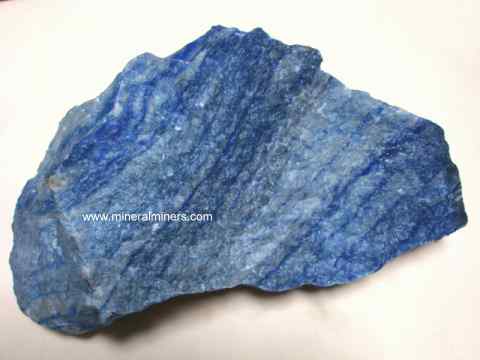
Blue aventurine is a quartzite, which is composed of macrocrystalline quartz grains with disseminated Dumortierite as the color imparting mineral.
There are many named quartzite varieties, usually based on the color.
See also our other Varieties of Quartz
Blue Aventurine Quartz Information Topics
Blue Aventurine Quartz Products For Sale in our Online Store:
(Take any link to enter our Virtual Gallery)Return to the Index of
BLUE AVENTURINE QUARTZ PHYSICAL PROPERTIES
- Blue Aventurine Quartz chemical composition: SiO2
colored blue by the mineral Dumortierite: (Al,Fe3+)7O3(BO3)(SiO4)3 - Class: tectosilicate
- Crystal system: Hexagonal-R; 32 (trigonal-trapezohedral)
- Crystal habit: massive aggregate of interlocking quartz grains
- Specific gravity: 2.64 to 2.69, higher with increasing Dumortierite content
- Index of refraction: 1.55, higher with increasing Dumortierite content
- Hardness: 7
- Color: blue
- Luster: dull vitreous
- Transparency: opaque
- Cleavage: none
- Fracture: conchoidal
- Streak: white
Return to the Index of
QUARTZ (Blue Aventurine Quartz) BACKGROUND INFORMATION
Quartz (SiO2) is the most abundant single mineral on earth. It makes up about 12% of the earth's crust, occurring in a wide variety of igneous, metamorphic and sedimentary rocks.
Quartz varieties are commonly separated into two groups based on the size of the individual grains or crystals; macrocrystalline quartz in which individual crystals are distinguishable with the naked eye, and cryptocrystalline quartz in which the individual crystals are too small to be easily distinguishable under the light microscope.
Some of the macrocrystalline quartz varieties are: Amethyst, Ametrine, Cat's-eye Quartz, Citrine, Phantom Quartz, Rock Crystal, Rose Quartz, Rutilated Quartz and Smoky Quartz.
Blue Aventurine Quartz and Green Aventurine Quartz are actually quartzites (a rock, not a mineral) composed essentially of interlocking macrocrystalline quartz grains with disseminated grains of other color imparting minerals.
The cryptocrystalline varieties of quartz may be separated into two types;
fibrous and microgranular. Chalcedony is the general term
applied to the fibrous cryptocrystalline varieties.
Agate is an example of a fibrous cryptocystalline
banded chalcedony variety of quartz. Carnelian, Chrysoprase and bloodstone
are other chalcedony varieties.
Chert is the general term applied to the granular cryptocrystalline
varieties of quartz. Flint and Jasper are examples of granular cryptocrystalline
quartz.
Return to the Index of
BLUE AVENTURINE QUARTZ OCCURRENCE AND DIAGNOSTIC FEATURES
Coarsely crystalline quartz is common in many rocks. Because of crystalline quartz's mechanical and chemical stability, it endures as detrital grains when quartz bearing rocks break down, and these grains can accumulate as sand and pebbles in sedimentary deposits. Some sedimentary deposits are composed almost entirely of quartz grains which can become cemented together with time leading to the formation of sandstones. When a quartz-rich sedimentary deposit or a sandstone undergoes high grade metamorphism (metamorphism is the alteration of a rock due to changes in heat, pressure or chemical environment), the original material alters to a compact rock composed of interlocking quartz grains known as quartzite.
Other minerals
may form in the quartzite during the high grade metamorphism, depending on
what impurities were present in the
original sandstone or sedimentary deposit. If aluminous sediments containing the element boron
were present, then the mineral
Blue aventurine quartz is characterized by its occurance, hardness, conchoidal fracture, specific gravity, refractive index and luster. Quartzite is distinguished from sandstone by its fracture, which passes through the grains in quartzite and around the individual grains in sandstone.
Return to the Index of
BLUE AVENTURINE QUARTZ HISTORICAL INFORMATION AND USES
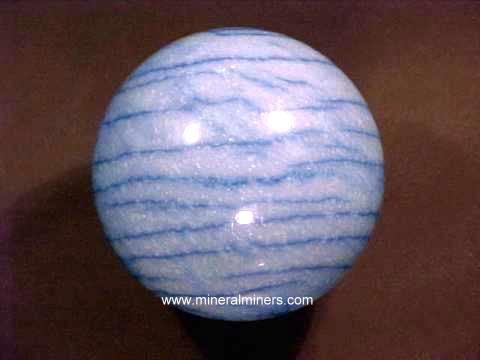
Aventurine rough has been worked by man into ornamental objects for thousands of years. Blue aventurine quartz is a popular lapidary material today, showing an attractive natural blue color when polished or when wet. Due to its relatively inexpensive price and beautiful color when wet, blue aventurine quartz has also been used as a decoration rock in fountains, aquariums, waterfalls and other indoor and outdoor landscape & design/decore projects.
Quartzite is also used as a building material.
Some of the earliest primitive stone tools (axes) fashioned by man's ancestors 2.5 million years ago in the Omo valley in Ethiopia, were made of quartz varieties such as quartzite. These materials were used because of their hardness and their isotropic brittleness which made it possible to shape the tools with relative ease.
The name quartz comes from a Saxon word meaning cross vein ore.
The astrological sign of blue aventurine quartz is Leo.
Blue aventurine quartz is an alternate birthstone for the month of August.
Return to the Index of
BLUE AVENTURINE QUARTZ METAPHYSICAL PROPERTIES
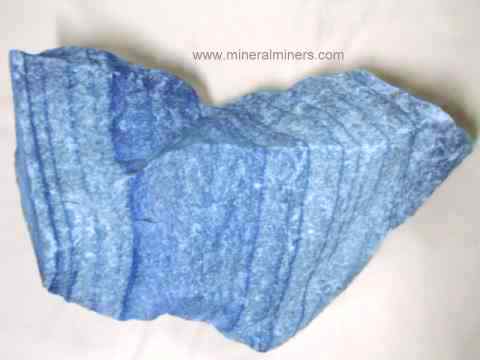
Blue aventurine quartz is said to provide patience, eliminate stubbornness, control excitability, and to give a deeper understanding of the cause and effect in situations thus allowing one to more fully understand and to find the optimum solution.
Blue aventurine quartz is also said to help release toxins from the body, to increase stamina, and to provide strength to those suffering from wasting diseases.
For more in-depth metaphysical information, see our Metaphysical Books section.
Return to the Index of
Blue Aventurine Quartz Items For Sale in our Store
(Select any link to enter our Virtual Gallery)Last Updated: November 15, 2021
© Copyright 1998-2021 Gem & Mineral Miners, Inc.® All Rights Reserved.