


Enter our Virtual Gallery of Mica Mineral Specimens
MINERALMINERS.COM®- Your Personal 'Link' Direct to the Mica Mines!TM
Mica: Mineral Information Page
Including the following Mica Varieties:
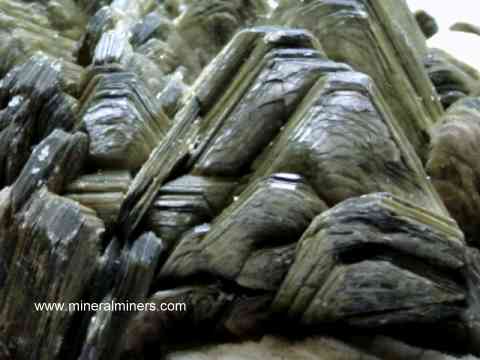
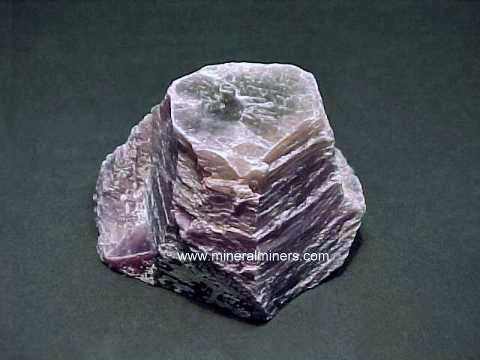
There are more than 20 chemically distinct mica species with considerable variance in geologic occurance, but all micas have essentially the same crystal structure.
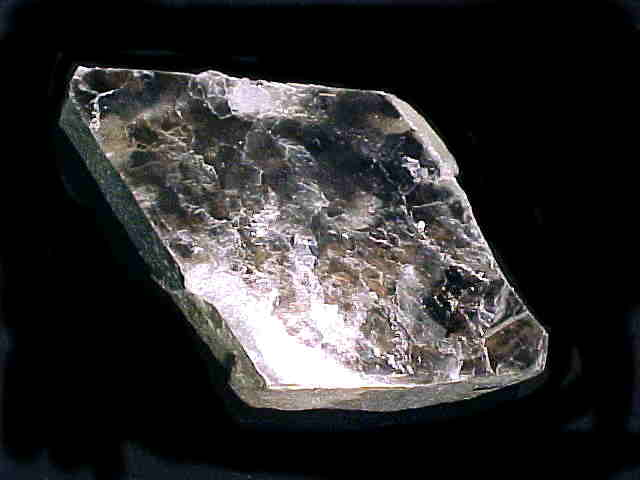
The micas crystallize with a sheet structure, the sheets being held together by relatively weak bonds resulting in the perfect basal cleavage of the micas. Some of the the most well known mica varities are muscovite mica, lepidolite mica, biotite mica, and fuchsite mica.
Mica Information Topics On This Page:
Micas
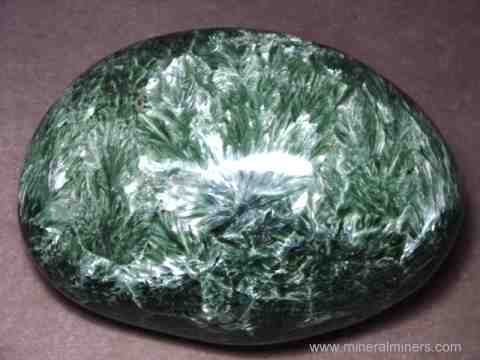
Mica Varieties (Biotite, Fuchsite, Lepidolite, Muscovite, Zinnwaldite) & Products In Our Online Mica Store
 |
 |
 |
 |
 |
 |
Return to the Mica Information Index
MICA PHYSICAL PROPERTIES
- Chemical composition of some of the mica varieties:
- Biotite: K2(Mg,Fe)6-5Al0-1(Si6-5Al2-3)O20(OH,F)4
- Fuchsite: K2(Al,Cr)4Si6Al2O20(OH,F)4
- Lepidolite: K2(Li4-3Al2-3)Si8-6Al0-2O20(OH,F)4
- Muscovite: K2Al4Si6Al2O20(OH,F)4
- Zinnwaldite: K2Fe1-2Li2-3Al2Si6-7Al2-1O20(OH,F)4
- Mica Class: phyllosilicates
- Mica Crystal system: monoclinic; 2m
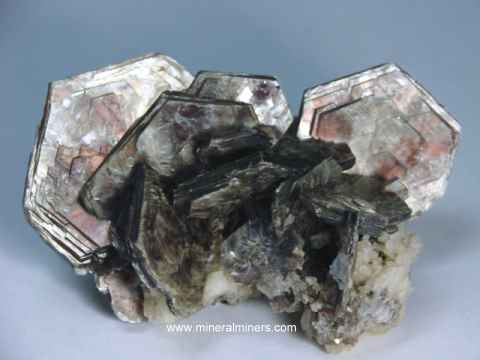
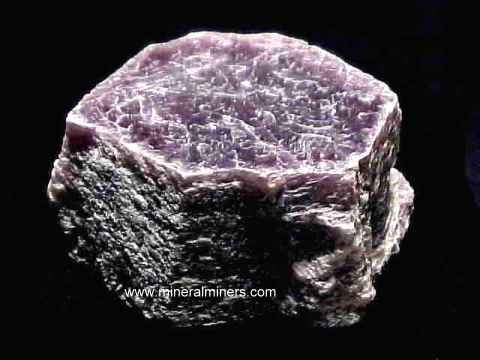
- Mica Crystal habit: platy, micaceous, also compact massive. Foliated sheets can be (rarely) aggregated into globular or botryoidal form, also cryptocrystalline. Distinct crystals are uncommon and are typically tabular with a book-like form with basal planes, showing a hexagonal or diamond-shaped outline. Prism faces are striated horizontally and frequently taper.
- Mica Twinning: occaisional twinning on {110}, a twin axis in the {001} composition plane forms the complex mica twin.
- Mica Specific gravity: 2.2 - 3.3 (biotite 2.7-3.3, lepidolite 2.2-3.3, muscovite 2.77-2.88, zinnwaldite 3.0)
- Mica Index of refraction: 1.53-1.70 (Biotite 1.56-1.70, lepidolite 1.52-1.59, muscovite 1.55-1.62, zinnwaldite 1.53-1.59)
- Mica Birefringence: .018-.070 (Biotite .04-.07, Lepidolite .018-.038, muscovite .036-.049, zinnwaldite .035)
- Mica Pleochroism: Biotite is strongly pleochroic in shades of brown or green, fuchsite in shades of green, lepidolite pale violet or green, muscoviteis colorless, zinnwaldite in pale yellow and brown to reddish-brown
- Mica Hardness: 2.0 -4.0, hardness is greater perpendicular to the cleavage (Biotite 2..5-3.0, Lepidolite 2.5-4.0, muscovite 2.0-2.5, zinnwaldite 3.0)
- Mica Color: Biotite is dark green, brown, or black (sometimes yellow), fuchsite is an emerald green, Lepidolite is pink to lilac to light gray, muscovite is colorless to light shades of yellow, brown, red or green, zinnwaldite is yellow, brown or gray.
- Mica Luster: vitreous, pearly, metallic
- Mica Transparency: translucent, transparent in thin sheets
- Mica Cleavage: perfect basal cleavage
- Mica Streak: white
Return to the Mica Information Index
MICA BACKGROUND INFORMATION
The micas are complex hydrous potassium-aluminum silicate minerals. There are more than 20 chemically distinct mica species with considerable variance in geologic occurance, but all have essentially the same crystal structure. The micas crystallize with a sheet structure, the sheets being held together by relatively weak bonds resulting in the perfect basal cleavage of the micas.
 Biotite is the most common of the micas, containing iron and/or
magnesium impurities substituting for octahedral aluminum.
Biotite is the most common of the micas, containing iron and/or
magnesium impurities substituting for octahedral aluminum.
Muscovite is the pure potassium mica, containing no impurities.
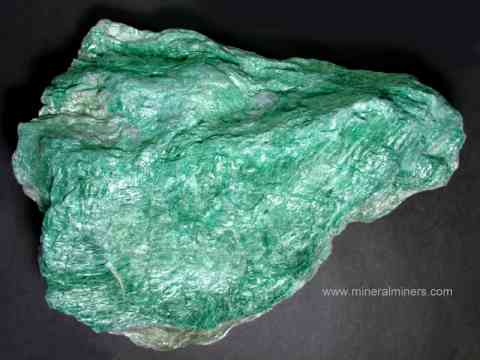
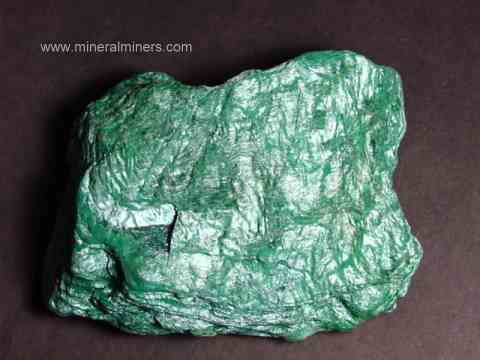
Fuchsite mica is a chromium rich variety of muscovite where chromium cations substitute for some of the octahedral aluminum in the muscovite crystal structure. The chromium impurities in fuchsite are responsible for its emerald green color. Lepidolite mica is a lithian mica where an occaisional lithium cation substitutes for some of the octahedral and tetrahedral aluminum in the mica crystal structure. Zinnwaldite is a lithian ferrous mica, where lithium and iron cations substitute for some of the octahedral and tetrahedral aluminum.
Return to the Mica Information Index
MICA GEOLOGIC OCCURRENCE & DIAGNOSTIC FEATURES
The micas have a very wide range of geological occurances. The many varieties of mica are distinguished by their chemical composition, some varieties occuring only in very specific geological settings while others have more widespread occurances.
Biotite mica is the most common of the micas, in fact it is the most common ferromagnesian mineral! It occurs in most igneous and metamorphic rocks and is commonly found in detrital sediments.
Muscovite mica also is a very widespread and common rock forming mineral. In igneous rocks it is characteristic of granites and granite pegmatites, and in metamorphic rocks it is very common especially in some mica schists where it is the most predominant mineral. In some mica schists and quartzites, muscovite crystallizes with chromium impurities resulting in the emerald green colored variety fuchsite. When microscopic flakes of fuchsite crystallize inside of quartzite giving it a green color, the rock is known as green aventurine quartz which is a popular lapidary material. Muscovite also commonly occurs as sericite, a fine-grained alteration product of other minerals.
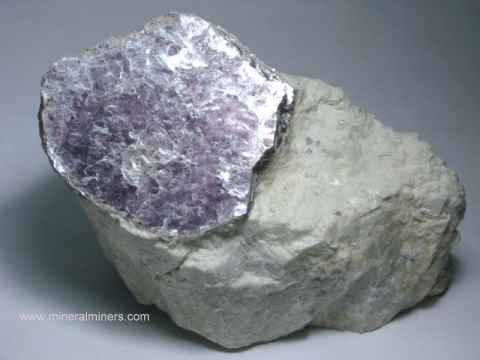
Lepidolite mica occurs mainly in granitic pegmatites associated with
quartz, microline,
albite, amblygonite, black tourmaline and occasionally the gem varieties of
tourmaline, aquamarine and spodumene (rarely as the gem spodumene variety kunzite).
Zinnwaldite mica occurs mainly in granite pegmatites and high temperature
hydrothermal veins.
The micas are usually recognized by their perfect basal cleavage. Some mica varieties can be distinguished with reasonable certainty by their color.
Return to our Mica Information Index
MICA HISTORICAL INFORMATION AND USES
The name mica was derived from the Latin micare which meant to shine. Biotite was named after the French physicist J. B. Biot. The name Muscovite was derived from the term muscovy-glass which it was previously known by because of its widespread use as a glass substitute in the old Russian state of Muscovy in the 14th century.
Mica (muscovite in particular) has a wide variety of uses as an insulating material in electrical equipment due to its strongly dielectric properties and to its good electrical resistivity and capacitance stability. Mica also has a low coefficient of expansion, and it has been used extensively because of its heat resisting properties. Mica is used extensively in paints to increase weatherability and to reduce running, it is also used in the manufacture of wallpapers to give them a silky or shiny luster. Mica is also used in the manufacture of lubricants and in dry-powder fire extinguishers.
The astrological sign of biotite is Scorpio, and the sign of muscovite is Aquarius.
Return to the Mica Information Index
MICA METAPHYSICAL PROPERTIES
 Biotite is said to enhance one's perception, allowing one to more
clearly understand what is really happening in any situation.
Biotite is said to enhance one's perception, allowing one to more
clearly understand what is really happening in any situation.
Fuchsite is said to enhance the body's ability to heal itself, and
to increase the effectiveness of other minerals that are being used in healing.
Lepidolite is said to be very soothing and to have a calming effect,
relieving anxiety and tension.
Lepidolite with pink tourmaline is said to bring happiness, joy
and increased vitality, and to inspire love.
Muscovite is said to increase one's understanding and perception,
and to enhance one's reflective abilities.
For more in-depth metaphysical information, see our Metaphysical Books section.
Enter our Virtual Gallery of Zinnwaldite Mica Mineral Specimens
See also our rare Clinochlore Mica Mineral Spheres
and our Seraphinite Jewelry
This is the end of our Mica Factsheet and Information page.
Go up to our Mica Information Index
Last Updated: October 16, 2024
© Copyright 1998-2024 Gem & Mineral Miners, Inc.® All Rights Reserved.