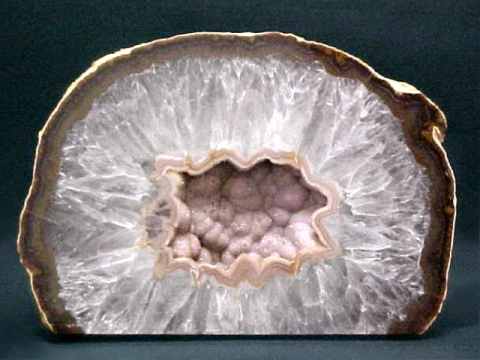
Enter our Virtual Gallery of Agate Mineral Specimens and Agate Geodes
Links To Agate Mineral Information Topics: Agates For Sale in our VIRTUAL GALLERY Agate Physical Properties Agate Background Info Agate Occurance and Diagnostic Features Agate History and Uses Agate Metaphysical Properties
Go up to the Agate Mineral Information Index
See all of our natural quartz varieties:
Agate is a cryptocrystalline variety of the mineral Quartz (SiO2). Quartz is the most abundant single mineral on earth. It makes up about 12% of the earth's crust, occurring in a wide variety of igneous, metamorphic and sedimentary rocks.
Quartz varieties are commonly separated into two groups based on the size of the individual grains or crystals; macrocrystalline quartz in which individual crystals are distinguishable with the naked eye, and cryptocrystalline quartz in which the individual crystals are too small to be easily distinguishable under the light microscope.
Some of the macrocrystalline quartz varieties are:AmethystAmetrineCat's-eye QuartzCitrinePhantom Quartz CrystalRock CrystalRose QuartzRutilated QuartzSmoky Quartz
Blue Aventurine Quartz and the well-known lapidary material Green Aventurine Quartz are both actually quartzites (a rock, not a mineral) composed essentially of interlocking macrocrystalline quartz grains with disseminated grains of other color imparting minerals.
The cryptocrystalline varieties of quartz may be separated into two types; fibrous and microgranular. Chalcedony is the general term applied to the fibrous cryptocrystalline varieties. Agate is an example of a fibrous cryptocystalline banded chalcedony variety of quartz. Carnelian, Chrysoprase and bloodstone are other chalcedony varieties. Chert is the general term applied to the granular cryptocrystalline varieties of quartz, of which flint and Jasper are examples.
Agate is a variety of chalcedony, which is the general term applied to fibrous cryptocrystalline quartz varieties. It is a mineral generally of secondary origin, forming in cavities and veins by deposition from meteoric groundwater containing gelatinous silica from the weathering of silicate minerals. It can also form by deposition from late hydrothermal solutions at or near the earth's surface under conditions of low temperature and low pressure. Agate is commonly associated with siliceous volcanics, occurring as vein or vesicle filling. It occurs as a petrifying agent in fossil wood and bone. Agate is frequently found lining or filling rock cavities and fissures, sometimes forming geodes.
Agate is characterized by its occurance, hardness, fracture, specific gravity, refractive index and luster.
The name agate is from an old locality on the achate river in southwestern Sicily.
Wearing agate jewelry has become very popular in recent times. Agate varieties have also been named for patterns or inclusions present in the agate such as lace agate jewelry, fire agate jewelry, banded agate jewelry, and moss agate jewelry.
Some agate varieties have been named for specific colors such as carnelian agate jewelry for orange-red agate jewelry items. There actually are dozens of named agate jewelry varieties!
Agate has been used as gemstones and other ornamental objects for thousands of years.
In medieval times, the wearing of agate was said to bring God's favor and make one agreeable and persuasive, giving victory and strength to the wearer and protection from all dangers. Wearing agate was also thought to give pleasant dreams and cure insomnia. Early Greeks made amulets of agate for protection from the elements of the sea.
Some of the earliest primitive stone tools (axes) fashioned by man's ancestors 2.5 million years ago in the Omo valley in Ethiopia, were made of quartz varieties such as agate. These materials were used because of their hardness and their isotropic brittleness which made it possible to shape the tools with relative ease.
The astrological sign of agate is gemini. Agate is a birthstone for the month of May. Agate is the symbolic gemstone for the 12th wedding anniversary.
Agate is said to enhance one's perceptiveness and to stimulate analytical capacity, and to provide balance between one's physical, emotional, intelectual and spiritual states. Agate is also said to alleviate hostilities and promote goodwill.
Agate is said to help treat disorders of the pancreas and to improve circulation.
For more in-depth metaphysical information, see our Metaphysical Books section.
AgateGeodes
AgateSpheres
AgateMineral Specimen
AgateJewelry
AgateRing
AgatePendant
AgateBracelet
Agate GeodeNecklace
AgateBook Ends
AgatePolished Slice
Lace AgateJewelry
DendriticAgate Jewelry
Moss AgateJewelry
Banded AgateJewelry
Fire AgateJewelry
Spectacular AgateDecorator Specimens
ChalcedonyJewelry
Black OnyxJewelry
CollectorQuality Agates
CarnelianJewelry
ChalcedonyNecklaces
AgateNecklaces