


Phantom Quartz Crystal Information
Enter our Virtual Gallery of
MINERALMINERS.COM®- Your Personal 'Link' Direct to the Quartz Crystal Phantom Mines!TM
Phantom Quartz: Mineral Information
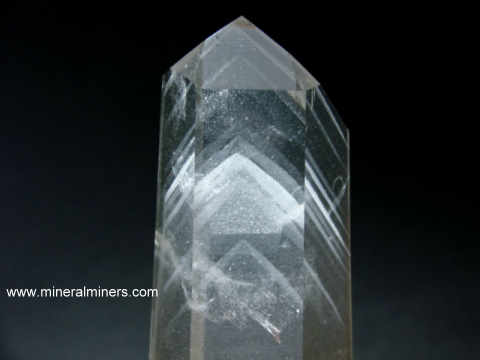
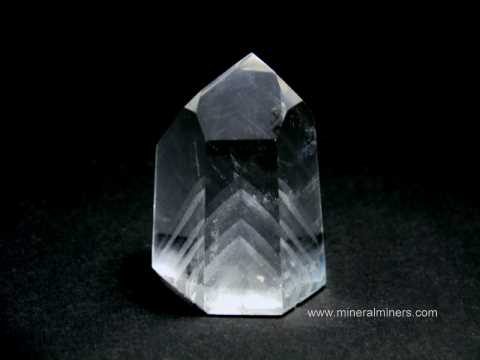
Phantom Quartz is a variety of quartz crystal with natural phantom crystal shapes in the interior of a quartz crystal.
There are dozens of named quartz varieties - see also our other Varieties of Quartz
Phantom Quartz Crystal Information Topics:
Phantom Quartz Products For Sale
(Take any link to enter our Virtual Gallery)
Return to the Index of
Return to the Index of
PHANTOM QUARTZ PHYSICAL PROPERTIES
- Phantom quartz chemical composition: SiO2
- Class: tectosilicate
- Crystal system: Hexagonal-R; 32 (trigonal-trapezohedral)
- Crystal habit: Macroscopic quartz crystals commonly occur as
horizontally striated hexagonal prisms terminated by a combination of
positive and negative rhombohedrons forming six sided pyramids. Prism
faces and/or rhombohedral terminations may be lacking, poorly developed
or predominant resulting in diverse possible crystal habits. Trigonal
tapezohedral faces can occur in the upper right or left of alternating
prism faces identifying right or left handed crystals, respectively.
- Twinning: Dauphine twin with c the twin axis, Brazil twin with {1120} the twin plane, Japanese twin is rare with {1122} the twin plane.
- Specific gravity: 2.65
- Index of refraction: 1.54-1.55
- Birefringence: maximum of 0.009
- Hardness: 7
- Color: phantoms are commonly green, milky white, or shades of orange, red, purple or brown
- Luster: vitreous
- Transparency: opaque to transparent
- Cleavage: none
- Fracture: conchoidal
- Streak: white
Return to the Index of
QUARTZ (Phantom Quartz) BACKGROUND INFORMATION
Phantom quartz is a macrocrystalline variety of the mineral quartz (SiO2). Quartz is the most abundant single mineral on earth. It makes up about 12% of the earth's crust, occurring in a wide variety of igneous, metamorphic and sedimentary rocks.
Quartz varieties are commonly separated into two groups based on the size of the individual grains or crystals; macrocrystalline quartz in which individual crystals are distinguishable with the naked eye, and cryptocrystalline quartz in which the individual crystals are too small to be easily distinguishable under the light microscope.
Some of the macrocrystalline quartz varieties are: Amethyst, Ametrine, Cat's-eye Quartz, Citrine, Rutilated Quartz, Phantom Quartz , Rock Crystal, Rose Quartz, Rutile in Quartz and Smoky Quartz.
Blue Aventurine Quartz and Green Aventurine Quartz
are actually quartzites (a rock, not a mineral) composed essentially of interlocking
macrocrystalline quartz grains with disseminated grains of other color imparting minerals.
The cryptocrystalline varieties of quartz may be separated into two types;
fibrous and microgranular. Chalcedony is the general term
applied to the fibrous cryptocrystalline varieties.
Agate is an example of a fibrous cryptocystalline
banded chalcedony variety of quartz. Carnelian, Chrysoprase and bloodstone
are other chalcedony varieties.
Chert is the general term applied to the granular cryptocrystalline
varieties of quartz, of which flint and Jasper are examples.
Opal is a hydrous silica mineral composed of SiO2 with some water incorporated within its structure.
Return to the Index of
PHANTOM QUARTZ OCCURRENCE AND DIAGNOSTIC FEATURES
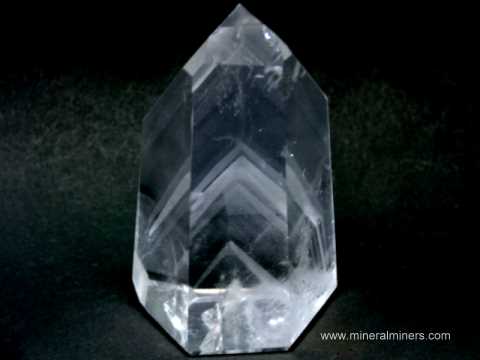
Phantom quartz usually occurs in rock crystal, but is also found in smoky quartz, citrine and amethyst.
Rock crystal is transparent and colorless quartz. It commonly occurs inside quartz veins where it crytallizes in rock cavities known as vugs or pockets. It also is common in vugs or pockets in pegmatite dikes. Rock crystal often occurs as secondary quartz crystals on cryptocrystalline quartz in cavities and vugs, and in geodes.
Natural radiation from radioactive elements or adjacent radioactive rocks can cause rock crystal to assume a brown to gray color, known as smoky quartz. Minor iron impurities can cause rock crystal to be purple (amethyst) or yellowish-orange (citrine).
Phantom quartz crystal shapes can sometimes be seen in the interior of quartz crystals, outlining an earlier stage of the crystal's formation. These phantoms are usually composed of other minerals such as chlorite, goethite or hematite or are composed of other varieties of quartz such as milky quartz, smoky quartz or even amethyst, which form on most or all of the surfaces of the quartz crystal at a particular point in time during its growth, after which the quartz crystal resumes its crystallization enclosing the phantom crystal outline within itself.
Phantom quartz is recognized by its characteristic phantom crystal within itself. It can be identified as quartz by its crystal habit, transparency, hardness, glassy luster, conchoidal fracture, occurance and general lack of cleavage.
Return to the Index of
PHANTOM QUARTZ HISTORICAL INFORMATION AND USES
Pliny wrote nearly 2000 years ago that quartz crystals formed from ice exposed to intense cold for long periods of time in dark clefts and caverns in the mountains. This general belief was popular in diverse cultures until the eighteenth century, when modern geology began to develope in Europe.
Phantom quartz crystals have been referred to as ghost crystals, spectre crystals and shadow crystals.
The name quartz comes from the Saxon word querklufterz which meant cross vein ore.
Return to the Index of
PHANTOM QUARTZ METAPHYSICAL PROPERTIES
Phantom quartz crystals are said to help one understand the various stages in life that we all evolve thru, and they are said to be an excellent tool for meditation and for remembrance of past lives.
For more in-depth metaphysical information, see our Metaphysical Books section.
See also our page with links to natural crystals of all mineral varieties!
Return to the Index of